In Pasurams of Nammalvar Aranmula is refered as Thiruvaranvilai, Lord Parthasarathy as Sree Thirukkurallappa Perumal, and Thayar (Mahalakshmi) as Padmasani Naachiyaar.
Parthasarathy Temple is situated on the left bank of the Pampa river in a beautiful village called Aranmula. Aranmula is a small village, but is one of the destinations as specified the Discovery channel, one would definitely like to visit. Aranmula is located in Pathanamthitta district, 9 km west to Chengannur. Parthasarathy Temple is one among the Pancha Pandava Temples(Thrichittat, Thirupuliyoor, Thiruvaranmula, Thiruvanvandoor and Thrikkodithanam) in Kerala. The Aranmula Parthasarathy Temple is vey famous and one of the biggest in Kerala. Aranmula is one among the 64 Brahmin gramams and Parthasarathy Temple is the Grama Kshetram. Lord Mahavishnu gave darsan to Lord Brahma and Vedavyasa at this place. Vishnu revealed the knowledge of creation to Bhrama, from whom the Madhu and Kaitabha demons stole the Vedas.
 Legends of this temple is associated with Pandavas. After crowning Parikshit, Pandavas left for piligrimage. They visited Kerala during their piligrimage. In Kerala, each of these brothers installed idols of Lord Vishnu on the banks of the Pampa and nearby places(Thrichittat - Yuddhishtra, Tiruppuliyoor - Bheema, Thiruvaranmula - Arjuna, Tiruvanvandoor - Nakula and Thrikkodithanam - Sahadeva) and offered worship. It is said that Arjuna built this temple at Nilackal near Sabarimala to expiate for the sin of having killed Karna on the battlefield, against the dharma of killing an unarmed enemy. Nilakkal was a dense forest and hence it was difficult to perform daily poojas. So the idol was brought here in a raft made of six pieces of bamboo to this site, and hence the name Aranmula (six pieces of bamboo).
There is yet another legend associated with Parthasarathy here. On the ninth day of the battle of Kurukshetra, the Kauravas reigned supreme under the leadership of Bheeshma, when krishna motivated Arjuna to take initative and vanquish his foe. Upon his hesitating to do so, Krishna jumped down in rage, and took up his Sudarsana Chakra(discus); seeing this sight Bheeshma surrendered to him and Arjuna beseeched him not to kill Bheeshma, as it would bave been against Krishna's vow to take up arms in his battle. It is believed that it is this image of Krishna that is enshrined here, with a discus.
This temple has golden flag staff and has four towers over its entrances on its outer wall. The huge beautiful eastern tower is accessed through a flight of 18 steps. Descending 57 steps through the northern tower, one can reach the Pampa river. This temple is a perfect example for Kerala Temple architecture and its structure is almost similar to that of Ettumanor Mahadeva Temple.
Parthasarathy is the owner of 39 villages in and around Aranmula and people in these villages consider Lord Parthasarathy as their protector. There are many legends associated with Lord Parthasarathy. Some of them are acssociated with the famous Uthrattathi Vallamkali(snake boat race) and Thiruvonathoni. The idol of Lord Parthasarathy was brought to this place from Nilackal in a raft made of six pieces of bamboo. Several Chundan Vallams(snake boats) accompanied the procession through Pampa river. The idol was installed in the temple on Uthrattathi day of Malayalam month Chingam(August-September). Uthrattathi in Chingam is the birthday of Arjuna. To celebrate these events people of Aranmula started the famous snake boat race Uthrattathi Vallamkali.
 It was a custom for the Bhattathirippad of Kattoor Mangatt Illam to offer lunch to Brahmins on the Thiru Onam day. This had been going on for years. One particular year, no brahmins turned up for the Onam Sadya. The Bhattathirippad prayed to Lord Parthasarathy to send a brahmin. Later a Brahmin boy came to the Illam and Bhattathirippad welcomed him for lunch. After the lunch as the boy was leaving, he told the Bhattathirippad "I will not come again here for lunch". That night, Bhattathirippad had a dream and understood that the boy was none other than Lord Parthasarathy. Lord Parthasarathy ordered him to bring rice and other material required for the 'Nivedyam' on Thiruvonam day from next year onwards. This made him decide to take particulars for Onam Sadya to Aranmula Temple from next year onwards. So the next year on Uthradam day - the day before Thirvonam, Bhattathirippad went to Aranmula Temple in a small thoni(boat) with rice and other material required for the Nivedyam. The chief priest of the Aranmula Temple had a dream on that night. "My devotte Mangatt Bhattathiri will bring the materials for Onasadya. You must receive him at the north gopuram. Make nivedyams with those materials." The priest informed this to the temple authorities and they decided to send some Palliyodams(holy snake boats) to welcome Bhattathiri. Bhattathiri reached the temple with the materials and surprised by the warm welcome. He handed over the materials and the Deepam(oil lamp) he brought from Kattoor Maha Vishnu temple to the priest. The priest lighted the lamps in side the sreekovil with this Deepam and the nivedyams were prepared and offered it to the Lord. A Kedavilakku is installed inside the sreekovil. There after it is a custom in this temple this tradition is continued even today.
 Later the Bhattathiri faced some difficulties at Kattur and decided to leave from there. Lord allowed him to go to Kumaranalloor and told him that there His sister Goddess Kathyayani will help him. But the condition is that Bhattathiri must reach the Aranmula temple for Thiruvonam with materials for nivedyam. Bhattathiri agreed and went to Kumaranalloor. Mangattu Illom is now situated at Kumaranalloor near Kottayam. Every year the Karanavar(the eldest member) of Mangattu Illam starts his journey in a small thoni(boat) to Aranmula two days before Thiruvonam. Bhattathiri will seek the blessings of Kumaranalloor Kathyayani Devi before starting the journey. The thoni will move towards Aranmula through Meenachil, Manimala and Pampa rivers. Bhattathiri will reach the Kattoor Maha Vishnu Temple on Uthradam day. The devotees will bring the materials for Onasadya and Bhattathri will receive them. From here onwards he travels in the famous Thiruvonathoni.The Garuda-faced Thiruvonathoni will set off from the Maha Vishnu Temple ghats at Kattoor, after the deeparadhana. On one occasion, the Thiruvonathoni was ambushed by scoundrels, and villagers' snake boats came to the rescue. Thereafter, all offerings for the feast were brought by snake boats. 'Paliyodams' belonging to the seven Palliyoda karas in the upstream of Kozhencherry will escort the Thiruvonathoni to Aranmula with the accompaniment of Vanchippattu, verses in praise of Lord Parthasarathy. It is a nice sight to see the thoni moving down the river Pampa without rowing. The thoni is symbolic of Lord vishnu's Garuda. On its way, the Thirvonathoni would first get to shore at Ayiroor madom and later at Melookara ashramam. The procession would reach Aranmula Temple by early morning of Thiruvonam and will be received at the temple ghats. The Onasadya will be served on the temple premises after the 'utchapuja' on Thiruvonam day.
But it is interesting that on Thiruvonam day the Karanavars(the eldest members) of four Illams in Aranmula will not take even a drop of water. These illams were once the Ooralars(owners) of the temple. The Aranmula Temple had land properties in nearby villages.Naranganam was such a village. Once, during paddy harvest season, the Ooralars were measuring the harvest in a paddy field. A poor, low caste woman waited to get some paddy as a tip. She waited until the evening but was completely ignored by the landlords. She had been starving for days. That night, the poor woman lay down in a field, and, by the next morning, she was dead. Thereafter, misfortunes began to fall upon Aranmula and the landlords under the temple. It was revealed that it was the divine curse caused by the death of the poor woman. So, it was suggested that the Karanavars of these families must not take food and water on Thiruvonam day and feasts should be given to the public – regardless of religion, caste, or financial status – every year.
 The Aranmula Uthrattathi Vallamkali, the world famous water carnival is the main important function related to this temple. The journey of the locals who used to accompany the Thiruvonathoni in their respective Palliyodams has evolved into the Aranmula Uthrattathi Vallamkali. This famous boat race in Pampa river will take place on Uthrattahy day in the Malayalam month of Chingam(August-September), 4 days after Thiruvonam. Palliyodams from 39 Karas from Chennithala in the west to Ranni in the east participate in the Vallamkali. These boats assemble since dawn and sail in pairs for about 2 hours. Though, large snake boats take part in this festival they do not race with each other. Instead, they row in union, to the accompaniment of songs and reach their destination together because Lord Krishna is believed to be present in each boat. The oarsmen, wearing white dhotis with white scarfs around their heads, row the snake boats to the rhythmic tunes of Vanchippattu. After the Vallamkali there is an elaborate feast in the Aranmula temple.
The Palliyodams have some peculiarities when compared with ordinary snake boats or Chundan Vallams. They are called Pallyodams because they belongs to the Lord. They are constructed so that the head and tail project out five and three feet, respectively, above the water. Each boat must have 64 seating compartments for 64 oarsmen, representing 64 art forms. At the head of the boat on a raised platform are seats for four more master oarsmen who control the direction of the boat with large oars. These four oarsmen symbolize the four Vedas. In the middle of the boat is a platform for eight people to stand. They represent the Ashtadikpalakas (devas), who guard the eight directions. A snake boat is about 103 feet in length. Each boat has about 4 helmsmen 100 rowers and 25 singers. The total cost of building a snake boat is about Rs 1.6 million. It takes 650 man-days to build a single snake boat.
This Vallamkali is an all-community affair and participants include members of all classes and communities living in and around Aranmula. For peoples in Aranmula this vallamkali is more important than Onam. All of the local people participate in the festival. And all the pilgrims who come to Aranmula become the guests of the resident families. The festival is now being organised under the auspices of the Palli Oda Seva Sangham, a popular organization of the boat owners. In recent years, the festival attracts spectators from all parts of the country and from abroad.
Ashtamirohini - birth day of Lord Krishna - is also celebrated here in a grand style.The famous ritualistic mass feast, Ashtami Rohini 'vallasadya', will be held on this day. Thousands of devotees from different parts of the State will take part in this feast and is considered as the 'prasadom' of the presiding deity. The Palliyoda Seva Sanghom (PSS) has been organising the vallasadya on the temple premises for the past several years. Rice is served along with 32 side dishes on the day. The vallasadya will begin in front of the holy temple mast immediately after the utcha pooja at the temple. More than 30 Palliyodams will participate in vallasadya and the temple premises will be packed with devotees right from the morning. The Palliyodams carrying devotees from each kara in and around Aranmula will stage the Ashtami Rohini boat race and will reach the temple ghats in a procession by 11 a.m. After a rousing reception they will circumambulate the temple, chanting the vanchippattu, verses in praise of Lord Krishna, before partaking of the vallasadya. For the vallasadya held in 2006, 3250 kg of rice had been used and not less than 40,000 people had partaken of the feast.
 There is a subshrine for Lord Balarama near to the northern gopuram. This shrine is located in a big pit and devotees have to step down to get the darsan of Lord Balarama. There is no other sub deities in this temple. The Thiruvonathoni is kept in a special place near to the western Gopuram.
The 10 day long annual festival in Makaram(January-February) begins with kodiyettam on Atham day and ends with arattu on Thiruvonam day. The malayala month of Meenam witnesses a festival where Aranmula Parthasarathy is taken in a grand procession on the Garuda Vahana to the Pampa river bank, where an image of the Bhagavathi from the nearby Punnamthode temple is brought in procession for the arattu festival. Another festival celebrated here is the Khandavadahanam celebrated in the malayalam month of Dhanus. For this festival, a replica of a forest is created in front of the temple with dried plants, leaves and twigs. This bonfire is lit, symbolic of the Khandava forest fire of the Mahabharata. It is from here that the sacred jewels of Lord Ayyappa are taken in procession to Sabarimala each year in Dhanu(December).
Vallasadya is a famous offering in Aranmula Temple. On this the offered village will conduct a boat race in the Pampa river and will have a feast at the temple. The feast will have hundreds of items and sweets. But the peculiarity of this offering is that it's not for Brahmins and only Nairs will attend this feast. Other main offerings are Chandanam Charthal, Pushpanjali and Palppayasam. This temple is managed by Travacore Devaswom Board.
Like Lord Guruvayoorappa, Lord Parthasarathy also like elephants. Now there are 3 elephants in this temple. Aranmula Valiya Balakrishnan and Gajarajan Aranmula Raghunathan were the famous elephants of Lord Parthasarathy.

 Mahadeva Temple located at Ettumanoor is about 17 kms away from Kottayam town. This ancient Siva temple in Kerala style of architectural was constructed in the 16the century (1542). The temple is famous for its mural paintings and carvings, especially the painting of Nataraja in the gopuram. The walls of the temples are adorn with scenes from Ramayana, Bhagawatam and other Hindu ethics. The main attraction of the temple is the Ezharaponnanan, i.e the seven large and one small elephants made of nearly 13 K grams of gold. These elephants were offered with devotion to the Lord by Karthikathirunal Maharaja of Travancore.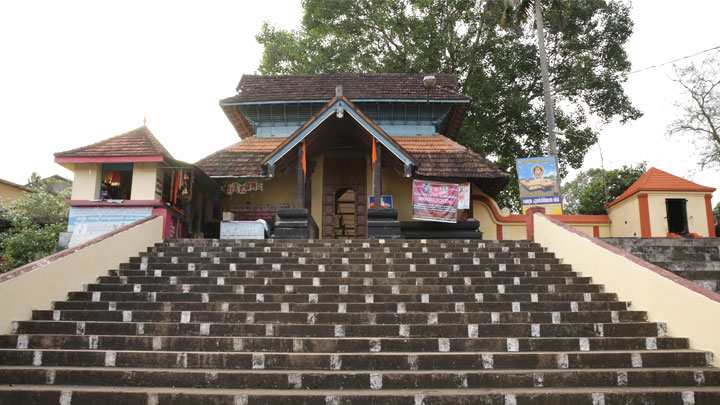
 Sabarimala Sree Ayyappa Temple is one of the most ancient and prominent Sastha temples in the country. Located in the Western Ghat mountain ranges of Pathanamthitta district in Kerala, Sabarimala Sri Dharmasastha Temple is one of the few Hindu temples in India that is open to all faiths. The shrine of Sabarimala is one of the most remote shrines in southern India yet it still draws three to four million pilgrims each year. Surrounded by mountains and dense forest Sabarimala is believed to be the place where Ayyappan meditated. Perhaps the best known pilgrimage destination in Kerala is Sabarimala. Sabarimala Sri Dharmasastha Temple is the most famous and prominent among all the Sastha Temples. It is believed that "Parasurama Maharshi" who retrieved Kerala from the sea by throwing his axe, installed the idol of Ayyappa at Sabarimala to worship Lord Ayyappa.